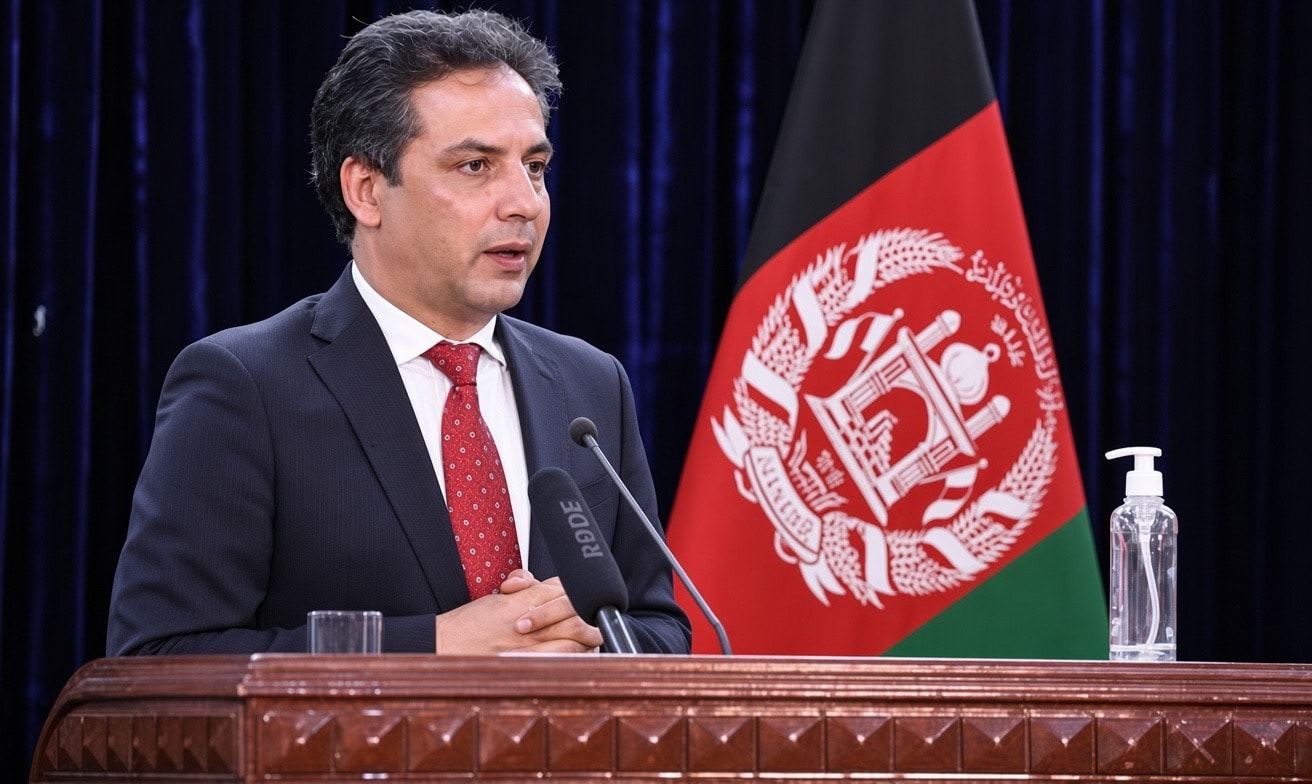
Wahid Omar, former head of Public and Strategic Communications for the Islamic Republic of Afghanistan and former Afghan ambassador to Italy, says that the apparent purpose of the final meeting of political leaders at the Presidential Palace on August 14, 2021, was to prevent fighting and bloodshed in Kabul. However, the meeting’s underlying message was that President Mohammad Ashraf Ghani should step down from power.
In a post on his Facebook page, Wahid Omar wrote that the meeting was attended by Hamid Karzai, Abdullah Abdullah, Fazel Hadi Muslimyar, Yunus Qanuni, Ustad Khalili, Ustad Mohaqiq, Batur Dostum, Hanif Atmar, and several other political leaders. According to Omar, a seat had also been reserved for Ustad Abdul Rab Rasul Sayyaf, but he did not attend the meeting.
Omar says the atmosphere at the meeting was highly tense. After the recitation of the Quran, President Ghani handed the microphone to Abdullah Abdullah and said that he was ready to hear the leaders’ views. Abdullah then asked Hamid Karzai to speak first.
According to Omar’s account, Karzai delivered an emotional speech expressing concern about the possibility of fighting and bloodshed in Kabul. He said that his own family was in Kabul and that he did not want to keep his children outside the country while remaining indifferent to the suffering of other Afghan families.
Karzai stressed that the time had come for difficult decisions and sacrifice, and that every effort should be made to prevent fighting, bloodshed, and destruction in Kabul. Abdullah Abdullah, Ustad Khalili, Ustad Mohaqiq, and Yunus Qanuni spoke afterward. According to Omar, the central message from all of them was the need to find a political solution to prevent fighting in Kabul.
Wahid Omar says the significance of this shift was that, only one day earlier, a security meeting had focused on resistance, holding the line, and defending Kabul. Yet at the August 14 meeting of political leaders, there was no longer any discussion of resistance.
According to Omar, during the preceding weeks, jihadi leaders had spoken about their capacity to defend various parts of the country and had asked the government to provide them with weapons, ammunition, and other resources. At the final meeting, however, the focus had shifted from defense to preventing a war.
Omar adds that President Ghani appeared to understand the leaders’ message and, at the conclusion of the meeting, said that he agreed with their proposals. He instructed that an empowered delegation be appointed to travel to Doha and hold discussions with the Taliban regarding a final decision.
During the meeting, Yunus Qanuni said that he and several other political leaders had been invited to Islamabad and wanted to travel to Pakistan. He asked the president for permission, but Ghani objected, saying that a visit by political leaders to Pakistan at such a sensitive juncture would send an inappropriate message.
According to Omar, Qanuni was dissatisfied with the decision and said that, if necessary, he did not need anyone’s permission to travel to Pakistan.
Afterward, Hanif Atmar, Abdullah Abdullah, Ustad Khalili, and Akram Khpalwak gathered in front of the Char Chenar Palace. According to Omar’s account, Atmar was concerned that the meeting’s underlying message had not been conveyed clearly enough to the president.
Omar says that Atmar and Abdullah Abdullah had concluded that the leaders’ main demand was not merely to stop the fighting, but to create the conditions for President Ghani to step down from power. Atmar proposed that he and Abdullah meet with Ghani again and raise the issue explicitly. However, Akram Khpalwak later informed them that President Ghani was unwilling to meet with Abdullah and Atmar.
According to Wahid Omar, the political leaders’ calculation at the time was that the Taliban’s primary problem was with President Ghani. They believed that if Ghani were removed from the political scene, the Taliban would reach an agreement with other political leaders on a division of power and that a power-sharing government might be formed.
However, Omar raises a fundamental question in his account: if the Taliban had reached the outskirts of Kabul with little serious resistance and knew that there was no genuine determination to fight in Kabul, why would they agree to share power with other political leaders?
He adds that if the Taliban were capable of seizing complete power by force, what would have compelled them, merely one day later in Doha, to share that power with other political leaders?
According to Wahid Omar, the answer to that question became clear in less than 24 hours.
Writer:Saeed Sameer