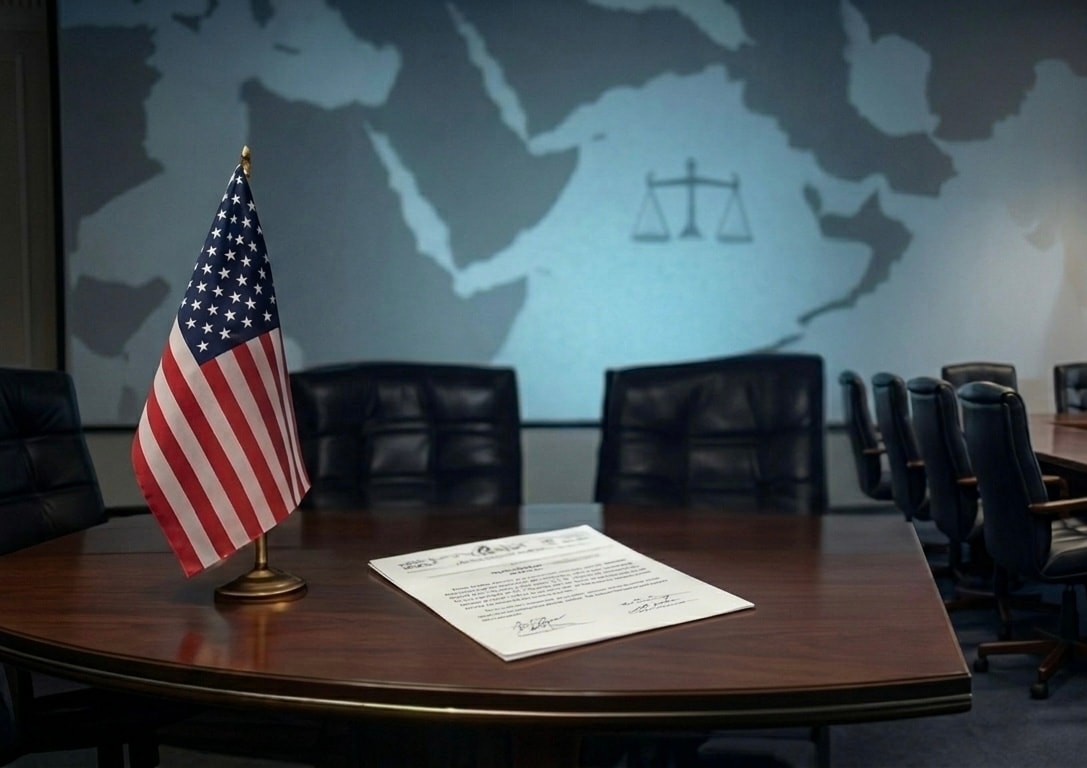
Three days after the online signing of a memorandum of understanding between Tehran and Washington, the confidentiality of the document has sparked reactions and questions regarding the nature of the agreement and the scope of obligations envisaged for both sides. While official authorities have not yet published the full text, media reports suggest the existence of a 14-point framework covering issues such as a ceasefire, sanctions, oil exports, and Iran’s nuclear program.
The United States of America and the Islamic Republic of Iran announced early on the 25th of Jowza that they had reached a preliminary understanding to end the war. According to both parties, this memorandum is scheduled to be formally signed in person in Switzerland on Friday, the 29th of Jowza.
According to reports published by media outlets including Al Arabiya, CNN, Bloomberg, and The Wall Street Journal, the main provisions of the document include an immediate end to hostilities, the lifting of maritime restrictions, the resumption of shipping traffic in the Persian Gulf and the Sea of Oman, the issuance of oil and banking waivers for Iran, the release of a portion of frozen assets, and the initiation of a process for Iran’s economic development.
Based on the same reports, the memorandum envisions that the United States and its regional partners will provide at least $300 billion in financial resources for a reconstruction and development program in Iran. The Islamic Republic has also reiterated its commitment not to pursue nuclear weapons.
The document is also said to pave the way for 60 days of negotiations toward a comprehensive and final agreement. According to the published provisions, the final agreement, if reached by consensus between the parties, would need to be adopted through a binding United Nations Security Council resolution.
In the first article of the memorandum, Iran and the United States, along with their allies, declare the immediate and permanent end of the war and commit to refraining from any hostile actions, threats, or use of force against one another. Respect for each other’s sovereignty and territorial integrity is also emphasized.
Another section of the document states that the two sides will negotiate a final agreement within a maximum of 60 days. This period may be extended by mutual consent, and the outcome of the negotiations is expected to define the framework of future relations between the two parties.
According to the published provisions, the United States will be obligated to lift the maritime blockade and ensure the full resumption of shipping within 30 days. In return, Iran has committed to taking necessary measures to ensure the security of maritime routes and restore commercial traffic to pre-war levels.
One of the most significant sections of the understanding concerns sanctions. Under this clause, the United States commits, within the framework of the final agreement, to lifting all sanctions related to Iran, including unilateral, primary, and secondary sanctions, and to pursuing the removal of international restrictions.
In the nuclear domain, the Islamic Republic has reiterated that it does not seek to develop nuclear weapons. It is also stipulated that issues related to enriched materials and other aspects of Iran’s nuclear program will be addressed and decided during future negotiations.
During the interim period between the signing of the memorandum and the achievement of a final agreement, both sides have agreed to maintain the status quo. Accordingly, Iran will not make changes to its nuclear program, and the United States will refrain from imposing new sanctions or increasing its military presence in the region.
The published text also states that the United States will immediately, following the signing of the memorandum, issue the necessary waivers for oil exports, petrochemical products, and related services, including banking, insurance, and transportation services. The unfreezing of Iranian assets is also among the provisions outlined in the document.
The reported provisions further emphasize the creation of a mechanism to monitor the implementation of the final agreement. Under this clause, both sides will be responsible for jointly overseeing the execution of commitments and compliance with the agreement in the future.
Despite the publication of parts of the agreement, it remains unclear whether the released versions fully correspond to the document expected to be signed on the 29th of Jowza in Switzerland. Official authorities of both countries have not yet published the final text.
CNN, citing a U.S. official, reported that the document it accessed is the same text digitally signed between the parties on the 25th of Jowza. However, the network emphasized that technical details of the agreement are still under review and finalization.
Meanwhile, U.S. President Donald Trump described the memorandum as “very strong,” but said the agreement is not yet final and its continued implementation depends on Washington’s satisfaction with the negotiation process and the behavior of the other party.
Reuters also reported that two issues previously raised by U.S. and Israeli officials namely Iran’s missile program and support for proxy groups are currently not listed as core topics in the upcoming negotiations.
Writer:Salima Aryaei