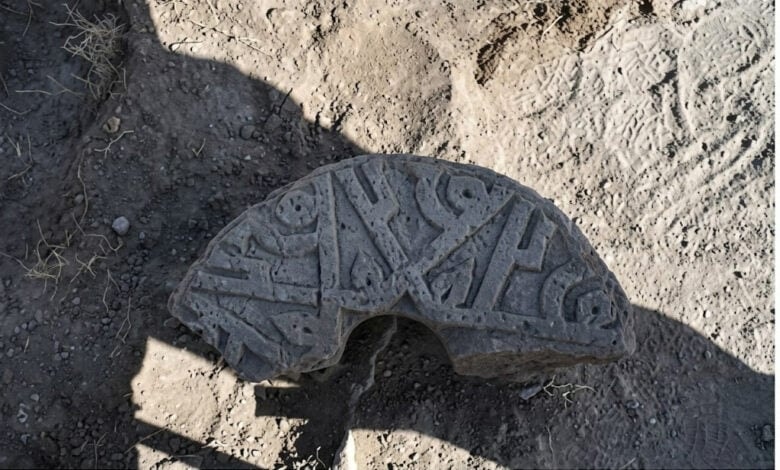
Seljuk stone bearing the name “Muhammad” discovered at the ancient site of ani in Turkey.
Archaeologists have discovered a decorative stone fragment dating to the Seljuk period during excavations at the historic site of Ani in Turkey’s Kars Province. The design features the name “Muhammad” written in Kufic script. The stone was unearthed during ongoing excavations at Ani’s Seljuk cemetery, where archaeological work has been underway since 2021.
The stone fragment measures 51 centimeters in length and 21 centimeters in width. At its center is an eight-pointed star, surrounded by an inscription in Kufic script. The name “Muhammad” appears several times as part of the original decorative design. However, because the stone has been damaged and only part of the original fragment remains, not all of the inscription is still visible.
According to experts, three instances of the inscription can be read on the surviving portion of the stone. Based on the structure and decorative pattern of the artifact, archaeologists believe that the name “Muhammad” may have been repeated six times across the complete design. Thus, the number six refers to the presumed original composition of the artwork rather than necessarily indicating the number of inscriptions visible on the surviving fragment.
Experts have also suggested that the stone may have formed part of a domed Seljuk-era mausoleum. However, this remains an archaeological hypothesis, and further investigations are underway to determine the stone’s original location and its connection to historic structures in the area.
The ancient site of Ani, located near the border between Turkey and Armenia, is regarded as one of the most important historical sites in the Caucasus and Anatolia. The historic city came under the rule of various states and dynasties throughout different periods, leaving behind architectural remains from several eras.
The discovery of the stone during ongoing excavations at Ani’s Seljuk cemetery provides new insights into the art, architecture, and use of religious inscriptions during the Seljuk period. Archaeologists hope that continued research will shed further light on the history of the stone and the structure of which it may once have been a part.
Writer:Salima Aryaei