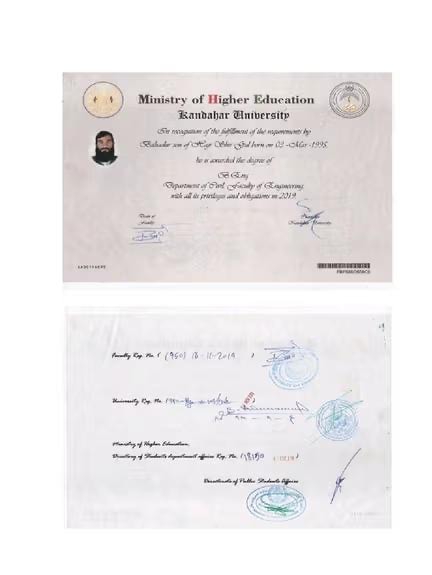
Following widespread criticism over the appointment of Mawlawi Bahadur Khalil as the dean of the Engineering Faculty at Herat University, Taliban supporters on social media published a document they claimed to be his academic certificate. They assert that he graduated in engineering from Kandahar University and also possesses relevant work experience.
The appointment of Mawlawi Bahadur Khalil to this position sparked broad reactions from university professors, students, and social media users. Critics of the decision have raised questions regarding the observance of scientific, professional, and academic standards in the appointment of university officials.
Despite the publication of the academic certificate by Taliban supporters, media outlets have so far been unable to independently verify the authenticity of the document.
Fazl Hadi Wazin, a religious scholar and university professor, stated in response to the appointment that the Taliban Ministry of Higher Education spokesperson’s response to the criticism, instead of addressing the core issue, was an attempt to shift the discussion from “academic and scientific standards” toward a “cultural and identity-based confrontation.”
He emphasized that the criticism is not related to individuals’ style of dress or religious orientation, but rather focuses on adherence to professional principles, higher education regulations, and accepted academic standards.
Wazin also questioned whether the leadership of a faculty, as a scientific and specialized position, can be entrusted to someone who has not been a member of a university’s academic staff, lacks experience in university teaching and research, and has not gone through the conventional stages of academic promotion.
According to him, Ziaullah Hashimi, spokesperson for the Taliban Ministry of Higher Education, instead of providing clear answers to these questions, reduced the issue to opposition to the style of dress of the appointed individual.
This university professor, who left Afghanistan after the Taliban returned to power and now lives in Turkey, wrote that a higher education system can only remain standards-based when academic principles, specialization, and meritocracy are not sacrificed for non-scientific considerations.
In recent years, the Taliban have handed a large portion of administrative and managerial positions to individuals affiliated with their movement. Critics say that in many of these appointments, prior involvement with the Taliban has been valued more highly than professional expertise and academic background.
After the collapse of the Islamic Republic of Afghanistan on August 15, 2021, and the Taliban’s return to power, a large wave of migration by Afghan citizens began and continues to this day. Among the migrants are journalists, poets, writers, university professors, students, and many specialists and professionals.
Reports indicate that over the past nearly five years, thousands of university professors have left Afghanistan. At the same time, Taliban oversight institutions have gained a broader presence within university environments, and reports have emerged regarding ideological monitoring and scrutiny of students’ beliefs in some universities.
Writer:Salima Aryaei