American officials announced on Friday that a commander of the Kata’ib Hezbollah group in Iraq, considered one of the groups close to the Islamic Republic of Iran, has been arrested on charges of planning attacks in the United States, Canada, and Europe. According to U.S. officials, some of these plans included attacks on Jewish sites.
FBI Director Christopher Wray stated that Muhammad Baqir Saad Dawood Al-Saadi, an official of Kata’ib Hezbollah, had long been under investigation and, according to him, had been involved in extensive international terrorist activities.
The U.S. had previously designated Kata’ib Hezbollah as a terrorist organization. Over the past years, this group has claimed responsibility for several drone and missile attacks against U.S. bases in Iraq and the broader Middle East.
The U.S. Department of Justice, without providing specific details about the time and place of Al-Saadi’s arrest, stated that he had been transferred to the United States and appeared before a federal judge in New York on Friday. Some media outlets, including ABC News, reported that he was arrested in Turkey and then handed over to U.S. authorities.
At the court session, the federal judge filed six terrorism-related charges against Al-Saadi and ordered his temporary detention. So far, little information has been released about his personal life, education, or background—a common situation for many commanders of Iraqi militia groups.
According to U.S. officials, Al-Saadi and his associates planned and coordinated at least 18 attacks in Europe and 2 attacks in Canada. These attacks were allegedly planned in response to U.S. and Israeli military operations against Iran on February 28 (equivalent to Esfand 9 in the Iranian calendar).
The U.S. Department of Justice also cited several attacks and arson attempts targeting synagogues, Israeli stores, and Jewish educational centers in cities such as Amsterdam and Munich. In one incident, an individual was arrested for stabbing two Jewish men in London and is awaiting trial.
U.S. officials have not yet provided precise details about Al-Saadi’s direct role in these attacks, but the court referred to propaganda videos released on social media affiliated with the group. It is also reported that Al-Saadi, during a phone call with an undercover FBI agent, discussed his and his associates’ roles in some attacks in Europe and Canada.
Court documents indicate that the accused also provided images and maps of a major Jewish synagogue in New York and two other Jewish centers in Los Angeles and Arizona to an undercover agent, requesting an attack on these locations. He also discussed the use of improvised bombs in phone calls, though ultimately no attacks were carried out.
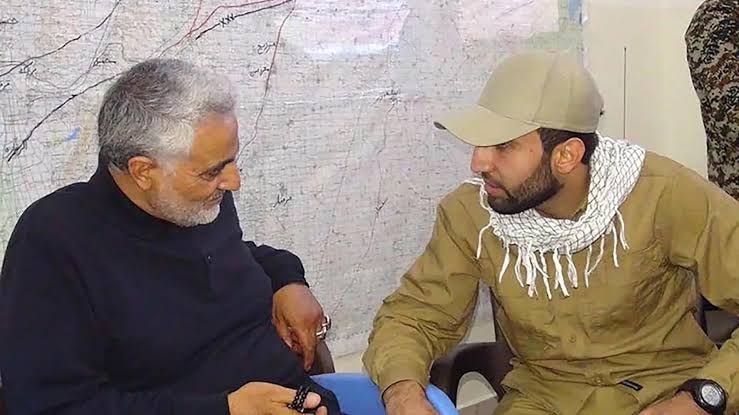
The U.S. Department of Justice stated that Al-Saadi previously had close cooperation with Qassem Soleimani, the former commander of Iran’s Quds Force. Soleimani was killed in a U.S. airstrike near Baghdad airport in January 2020.
Reports also show that British intelligence had previously investigated Kata’ib Hezbollah’s activities and expressed concern over the group’s plans to expand attacks on U.S. soil.
Kata’ib Hezbollah is a Shiite militia group in Iraq that emerged after the U.S. invasion of the country and during the unrest following 2003. The group is considered one of the closest Iraqi groups to the Islamic Republic of Iran and the Quds Force.
The group was established around 2007, initially aiming to counter the U.S. presence in Iraq. Kata’ib Hezbollah presents itself as part of the “Resistance Axis,” a collection of Iran-aligned groups in Iraq, Lebanon, Syria, Yemen, and Palestine.
The U.S. and several analysts believe this group receives financial, military, and training support from Iran. Conversely, Iranian officials usually refer to these groups as “resistance forces” but do not officially confirm direct involvement in their operations.
One of the most significant events related to this group was the killing of Abu Mahdi al-Muhandis alongside Qassem Soleimani in a U.S. drone strike in Baghdad. Al-Muhandis was one of the main figures and a founder of Kata’ib Hezbollah.
Although Kata’ib Hezbollah is not officially a political party, it wields significant influence in Iraq’s security and political structures and cooperates with some Shiite factions close to Iran. Critics consider the group to have extensive military and political influence in Iraq, while supporters highlight its role in fighting ISIS and defending Iraq.
Writer:Salima Aryaei