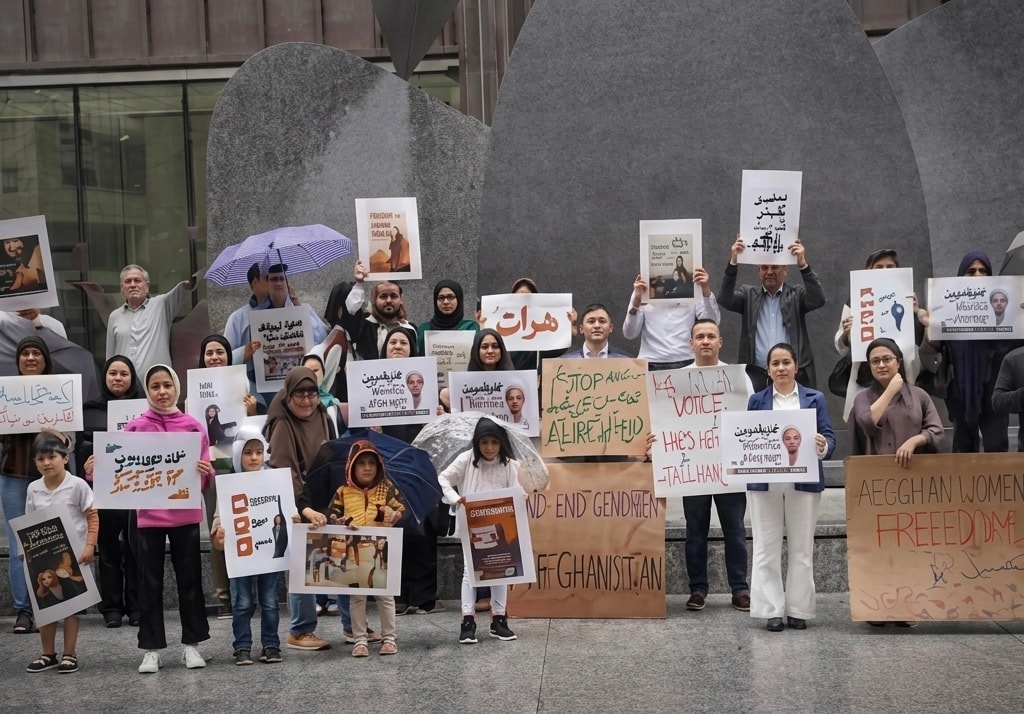
Afghans residing in the city of Chicago, United States, have called on the international community during a protest gathering to recognize the ongoing restrictions on women and girls in Afghanistan as “gender apartheid” and to take practical political, legal, and diplomatic measures to prevent this situation.
In the gathering, which was held in Chicago, participants stated in a resolution that human rights violations in Afghanistan particularly against women and girls are taking place in a “systematic” manner, and that this situation has raised deep international concern.
The protesters emphasized that the restrictions imposed on women are not random measures, but part of an organized and deliberate policy aimed at excluding women from education, work, and social life. In their view, these actions constitute a clear example of gender apartheid and are in direct contradiction with the principles of the United Nations Charter and the Universal Declaration of Human Rights.
The resolution called on international bodies, particularly the United Nations Security Council, the United Nations Human Rights Council, and the International Criminal Court, to establish an independent international mechanism for the documentation, investigation, and recording of violations of Afghan women’s rights.
It also demanded that the perpetrators and those responsible for these violations be investigated, prosecuted, and held accountable under international law.
Participants urged governments and international organizations to refrain from policies and engagements that contribute to the normalization or legitimization of gender discrimination in Afghanistan. They stressed that the rights of women and girls to education, work, and social participation must be guaranteed, and that civil activists should receive strong protection and support.
The protests come amid reports from various parts of Afghanistan, particularly Herat, of women being detained on charges related to improper hijab compliance, as well as the suppression of civil activists developments that have triggered widespread reactions.
Writer:Saeed Sameer